
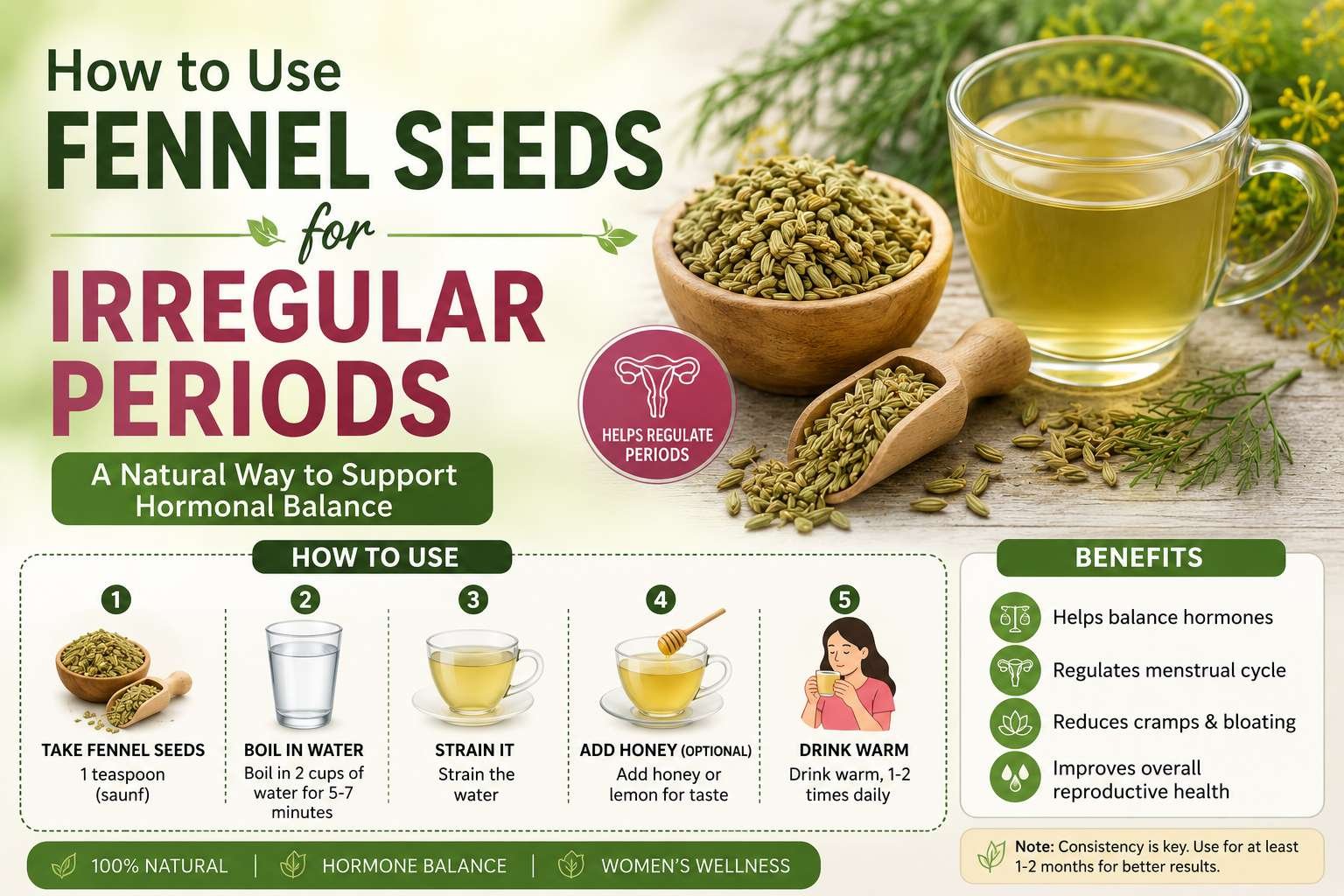
Fennel Seeds for Irregular Periods: An Ayurvedic Practitioner's Guide to Saunf and Hormonal Balance
Quick Summary (Key Takeaways)
- Fennel seeds (saunf) contain plant compounds called phytoestrogens that can gently interact with the body's estrogen receptors, which is why they're traditionally linked to menstrual regulation.
- Clinical research on fennel is strongest for menstrual cramps (dysmenorrhea) and PMS; evidence for actually fixing an irregular cycle length is preliminary, not conclusive.
- In Ayurveda, saunf is valued for balancing Vata and Pitta dosha, improving Agni (digestive fire), and clearing Ama (metabolic toxins) that are believed to obstruct healthy Artava (menstrual) flow.
- Fennel is a supportive remedy, not a replacement for diagnosis — irregular cycles lasting more than 2–3 months warrant a proper hormonal work-up to rule out PCOS, thyroid dysfunction, or uterine pathology.

Introduction
A patient walked into my clinic last month holding a screenshot of her period-tracker app — three months of gaps, unpredictable flow, and a search history full of home remedies. She'd already started drinking fennel water every morning because her grandmother swore by it. That's a familiar scene. Saunf sits in almost every Indian kitchen, and it has a genuine, centuries-old place in women's health traditions across Ayurveda, Unani, and Persian medicine.
This guide goes beyond the usual "soak it overnight and drink it" advice. We'll look at what's actually happening inside the body when fennel is consumed, what the clinical trial data says (and doesn't say), how Ayurveda explains its action through dosha and dhatu theory, and — most importantly — where fennel's limits are and when you need a doctor instead of a spice jar.
What Makes Fennel Seeds Biologically Active?
Direct Answer: Fennel seeds contain anethole, phytoestrogens, flavonoids, and volatile oils that give the herb mild estrogen-like, antispasmodic, and anti-inflammatory effects, which is the biological basis for its traditional use in menstrual health.
Fennel (Foeniculum vulgare) is a member of the Apiaceae family, related to carrots, celery, and cumin. The seeds — technically dried fruits — are packed with:
- Anethole — the primary volatile oil compound, structurally similar to catechol estrogens, giving fennel its mild phytoestrogenic activity
- Flavonoids (quercetin, rutin) — antioxidants that reduce oxidative stress on reproductive tissue
- Potassium and magnesium — minerals involved in smooth muscle relaxation, which may ease uterine cramping
- Volatile oils — with documented antispasmodic action on smooth muscle, similar to how the herb is traditionally used for digestive colic
How This Connects to Menstrual Regularity
A menstrual cycle depends on a tightly timed hormonal relay between the hypothalamus, pituitary gland, and ovaries (the HPO axis). Estrogen and progesterone need to rise and fall in the right sequence for ovulation and a predictable bleed to occur. When fennel's phytoestrogens interact with estrogen receptors, they may exert a mild, adaptogenic-like modulating effect — supporting estrogen activity in genuinely low-estrogen states, while theoretically buffering excess estrogen signaling in other states. This dual-direction, receptor-modulating behavior is typical of plant phytoestrogens generally, though fennel-specific dose-response data in humans remains limited.
Fennel's action on prolactin is also worth understanding. Elevated prolactin (hyperprolactinemia) is a well-documented cause of irregular or absent periods, and some animal and preliminary human studies suggest fennel compounds may help modulate prolactin secretion — one of the proposed mechanisms behind its traditional use for delayed or scanty periods.
What Does the Clinical Evidence Actually Show?
Direct Answer: Randomized trials show fennel is genuinely effective for reducing menstrual pain (primary dysmenorrhea) and PMS symptoms. Evidence specifically for correcting irregular cycle length is preliminary and comes mostly from small studies or traditional-use reports, not large-scale trials.
It's important to separate what fennel has been rigorously studied for versus what it's popularly used for:
- Dysmenorrhea (period pain): Multiple randomized controlled trials, including a well-cited Iranian trial on college students with primary dysmenorrhea, found oral fennel extract significantly reduced pain severity and duration compared to placebo, with effects considered comparable to standard analgesics in some studies.
- PMS symptoms: A review covering several clinical trials found fennel-based preparations reduced physical and emotional PMS symptoms such as mood swings, breast tenderness, and headache in the days before menstruation.
- Menopausal symptoms: A systematic review and meta-analysis of randomized trials found fennel improved menopausal symptom scores compared with placebo, although researchers flagged bias concerns in some of the included studies.
- Menstrual bleeding volume: Findings here are mixed — one meta-analysis found fennel oil increased bleeding volume in the first treated cycle but not the second, suggesting any effect on flow may not be consistent or lasting.
- Cycle-length regulation specifically: This is the least-studied claim. Most of the "fennel regulates irregular periods" narrative is extrapolated from its estrogenic and prolactin-modulating properties rather than from trials directly measuring cycle regularity over multiple months.
The honest takeaway: fennel has real, trial-backed value for period pain and PMS. Its role in "fixing" an irregular cycle is biologically plausible and traditionally well-supported, but it should be framed as a supportive measure, not a guaranteed fix.
The Ayurvedic Perspective: Saunf, Dosha, and Artava Vaha Srotas
Direct Answer: Ayurveda classifies irregular periods (Anartava/Asrigdara) as a disturbance in the Artava Vaha Srotas, usually driven by aggravated Vata or Pitta dosha and weak Agni. Saunf is considered a Vata-Pitta pacifying, Deepan-Pachan (digestive-kindling) herb that supports smooth Artava flow.
In classical Ayurvedic texts, menstruation (Artava) is governed by Vata dosha, which controls downward movement (Apana Vata) needed for the cycle to flow on time. When Vata is aggravated — through stress, irregular sleep, excess travel, or a cold/dry diet — the downward flow becomes erratic, causing delayed, skipped, or unpredictable periods.
Two other classical concepts matter here:
- Agni (digestive fire): Weak Agni leads to incomplete digestion and the formation of Ama, a toxic metabolic residue. Ama is believed to clog the srotas (channels), including the Artava Vaha Srotas, disrupting hormonal signaling.
- Rasa and Rakta Dhatu: These are the first two of the seven Dhatus (tissues) in Ayurvedic physiology, and Artava is considered an upadhatu (sub-tissue) of Rasa Dhatu. Poor nutrition or a compromised Agni directly weakens Rasa Dhatu, which classical texts link to menstrual irregularities.
Fennel is classified in Ayurveda as having a Katu Vipaka (pungent post-digestive effect) and a mildly warming, Deepan-Pachan quality — meaning it kindles Agni, helps clear Ama, and pacifies aggravated Vata, all of which are believed to restore smoother Artava flow. This is precisely why it's traditionally combined with warm water or taken on an empty stomach, timings meant to maximize its Agni-kindling effect.
Complementary Ayurvedic Herbs Often Paired With Fennel
- Ajwain (carom seeds) — further supports Agni and reduces bloating-related Vata aggravation
- Shatavari (Asparagus racemosus) — a classical rasayana for female reproductive tissue, often combined for a broader hormonal-support formula
- Dried ginger (Sunthi) — used to enhance circulation and warmth, complementing fennel's own mild warming action
Practical Ways to Use Fennel Seeds (With Realistic Expectations)
Direct Answer: The most common methods are overnight-soaked fennel water, brewed fennel tea, and fennel powder in warm water, taken consistently for at least 2–3 full cycles before evaluating results.
1. Overnight Soaked Fennel Water
- Soak 1–2 teaspoons of whole fennel seeds in a glass of water overnight
- Strain and drink on an empty stomach in the morning
- This slow-infusion method is gentle on digestion and is the version most Ayurvedic practitioners recommend for daily, long-term use
2. Fennel Tea (Saunf Kadha)
- Add 1 teaspoon of lightly crushed fennel seeds to a cup of boiling water
- Steep for 8–10 minutes, then strain
- Best consumed once in the morning and once in the evening, particularly during the week before an expected period, when Vata-related discomfort tends to peak
3. Fennel Powder With Warm Water
- Mix ½ teaspoon of home-ground fennel powder into warm water
- Drink once daily, ideally on an empty stomach
- Store the powder in an airtight container away from moisture to preserve the volatile oils that carry most of its active benefit
4. Culinary Integration
Adding fennel to spice blends, dals, and soups won't deliver a concentrated therapeutic dose, but it supports long-term digestive and hormonal health as part of an overall Ayurvedic diet pattern (Ahara).
Modern Science vs. Ayurvedic View: A Quick Comparison
| Aspect | Modern Biomedical View | Ayurvedic View |
|---|---|---|
| Root cause of irregularity | HPO-axis disruption, PCOS, thyroid dysfunction, stress-related cortisol elevation | Vata dosha aggravation in Artava Vaha Srotas, weak Agni, Ama accumulation |
| Fennel's proposed action | Phytoestrogenic and prolactin-modulating compounds, antispasmodic volatile oils | Vata-Pitta pacifying, Deepan-Pachan (digestive kindling), Ama-clearing herb |
| Strongest evidence | Dysmenorrhea and PMS symptom relief (RCT-backed) | Centuries of traditional use for Artava disorders (empirical, not RCT-backed) |
| Recommended duration | Not standardized in trials; most studies run 2–3 cycles | 1–3 menstrual cycles minimum for noticeable change |
| Limitation | Limited large-scale trials on cycle-length correction specifically | Not diagnostic — cannot distinguish PCOS, thyroid, or structural causes |
Dosage, Administration, and Precautions
Direct Answer: A typical home-use dose is 1–2 teaspoons of whole seeds (or ½ teaspoon of powder) daily, for no longer than 3 consecutive months without medical review, avoided entirely during pregnancy unless supervised.
- Typical daily dose: 1–2 teaspoons of whole seeds as tea or soaked water; ½ teaspoon if using powder
- Avoid high concentrations: Fennel essential oil and concentrated extracts are far stronger than kitchen-grade seeds and should only be used under professional guidance
- Pregnancy and breastfeeding: Avoid medicinal doses of fennel during pregnancy due to its estrogenic activity; consult your obstetrician before use while breastfeeding, since fennel is also traditionally used as a galactagogue
- Allergy caution: Those with known allergies to carrot, celery, mugwort, or other Apiaceae-family plants may cross-react to fennel
- Drug interactions: Because fennel has estrogenic activity, discuss use with your doctor if you're on hormonal contraceptives, hormone replacement therapy, or fertility medications
- Underlying conditions: Women with estrogen-sensitive conditions (such as certain fibroids or endometriosis subtypes) should use fennel only under practitioner supervision, given its phytoestrogenic action
When to Consult a Doctor
Direct Answer: See a gynecologist if your cycle is consistently shorter than 21 days or longer than 35 days, if periods stop for 3+ months without pregnancy, or if irregularity comes with severe pain, heavy bleeding, or unexplained weight changes.
Home remedies like fennel are appropriate for mild, occasional irregularity — not for these red-flag patterns:
- Periods absent for three or more consecutive months (secondary amenorrhea)
- Cycles consistently shorter than 21 days or longer than 35 days
- Soaking through a pad or tampon every hour for several consecutive hours
- Severe pelvic pain that disrupts daily activities
- Irregular periods accompanied by excess facial hair, acne, or rapid weight gain (possible PCOS indicators)
- Irregular periods with fatigue, cold intolerance, or hair thinning (possible thyroid involvement)
- Any irregularity in a woman actively trying to conceive for more than 6–12 months
A basic hormonal panel (TSH, prolactin, LH/FSH ratio, and pelvic ultrasound) can rule out the common underlying causes that fennel alone cannot fix.
Frequently Asked Questions
Can fennel seeds bring on a delayed period immediately? Not reliably. Fennel's traditional use for delayed periods relates to gradual circulatory and hormonal support, not an immediate withdrawal-bleed effect like a prescribed medication would produce.
Is it safe to take fennel seeds every day long-term? Culinary amounts used occasionally in cooking are generally safe long-term, but concentrated daily doses for menstrual support are best limited to a few months at a time, with breaks and medical review.
Can fennel seeds help with PCOS-related irregular periods? Fennel may ease associated symptoms like cramping, but PCOS is a metabolic and hormonal condition that needs proper diagnosis and, typically, a structured medical and lifestyle treatment plan alongside any herbal support.
How is fennel different from fenugreek for periods? Fennel (saunf) is primarily used for its phytoestrogenic and antispasmodic effects, while fenugreek (methi) is more associated with blood-sugar regulation and lactation support; both appear in Ayurvedic menstrual formulas but act through different mechanisms.
Can teenagers with irregular periods use fennel seed remedies? Cycle irregularity is common in the first few years after menarche and often resolves naturally; mild culinary use of fennel is generally low-risk, but any concentrated remedy for a teenager should be discussed with a pediatrician or gynecologist first.
Medical Disclaimer
This article is written for general educational and informational purposes only and does not constitute medical advice, diagnosis, or treatment. Fennel seeds and other herbal remedies discussed here are traditional and complementary measures, not substitutes for professional medical evaluation. Always consult a qualified gynecologist, endocrinologist, or registered Ayurvedic physician before starting any new herbal regimen, particularly if you are pregnant, breastfeeding, managing a chronic condition, or taking hormonal medication. drmomcare.in and the author assume no liability for outcomes resulting from self-directed use of the information provided.
Verified References & Further Reading
- Rahimi R, Ardekani MR. "Medicinal properties of Foeniculum vulgare Mill in traditional Iranian medicine and modern phytotherapy." Chinese Journal of Integrative Medicine / reviewed in EXCLI Journal — summarized in "Foeniculum vulgare as Valuable Plant in Management of Women's Health," PubMed.
- Khorshidi N, Ostad SN, Mosaddegh M, Soodi M. "Clinical effects of fennel essential oil on primary dysmenorrhea." Iranian Journal of Pharmaceutical Research, 2010. (Cited via PubMed ID 23983742, "Oral fennel drop effect on primary dysmenorrhea.")
- "A Narrative Review of Foeniculum vulgare: Mechanisms of Action, Biological Effects, and Clinical Applications in Dysmenorrhea." Nutrition and Dietary Supplements (Dove Medical Press), 2025–2026 review.
- "Fennel (Foeniculum vulgare Miller) for the management of menopausal women's health: A systematic review and meta-analysis." PubMed ID 33725577.
- Charaka Samhita, Sharira Sthana (classical Ayurvedic text) — foundational reference for Artava Vaha Srotas physiology and Vata dosha's role in menstrual regulation, as interpreted in contemporary Ayurvedic gynecology literature.
This article was reviewed for accuracy by Rishi K Sharma, Wellness Expert, drmomcare.in, integrating classical Ayurvedic literature with current peer-reviewed clinical research.
Frequently Asked Questions

Related Articles